I have always loved the idea of sewing a fabric liner for Easter baskets. It just levels up the cuteness by a lot. You can buy lined baskets, of course, but they are more expensive and often the liners are pretty cheap, thin fabric. (They are pretty cute, I’ll admit. But I don’t want to pay so much for such poor quality.)
So it’s been on my to-do list for a loooong time to make a custom pattern for one of our Easter baskets. I finally did.
This method gives you a tailored, fitted liner. There’s no gathering stitch on this one like there was on my oval basket liner. You’ll just get a clean, pretty liner you sewed yourself, from cute fabric you actually like.
Fair warning: this job takes math. But don’t worry if math isn’t your thing. If I can do it, anyone can do it! I’ll walk you through every calculation, step by step, so you know exactly what to cut.
Materials Needed to Make an Easter Basket Liner
Links provided to materials will be affiliate links whenever possible. As an Amazon associate, I earn from qualifying purchases.
- Your round basket with handles
- Cotton fabric (I used a plaid quilting cotton from Walmart — about half a yard was plenty for my basket)
- A flexible measuring tape OR a piece of string and a ruler
- Scissors or a rotary cutter, ruler, and cutting mat
- Sewing machine
- Pins or clips (double-sided sewing tape/DST is a great option for pinning the circle to the side panels)
- Iron and ironing board
- Fabric marking pen or chalk
- Ribbon or fabric strips for ties (4 equal pieces)
How to Sew a Fabric Easter Basket Liner
Overview:
I’m not gonna lie: the directions look intimidating at first, but you’re just doing four things (really!):
- Measure
- Cut 3 pieces of fabric
- Sew them together
- Make ties and sew them to the liner
Step 1: Measure Your Basket
Baskets are wonderfully imperfect, so your measurements will be approximate — and that’s okay. You need four measurements:
- Inside diameter at the bottom. Measure straight across the inside of the basket at its lowest point. This is your bottom circle size.
- Inside diameter at the top. Measure straight across the inside opening at the top.
- Inside height. Measure straight up the inside wall of the basket from bottom to top rim.
- How far you want the liner to hang over the outside. About 2 to 2.5 inches is typical and looks nice, depending on the size of the basket.
Tip: If you don’t have a flexible measuring tape, use a piece of string to measure around curves, then lay the string flat against a ruler.
Step 2: Calculate and Cut Your Bottom Circle
The bottom circle is the foundation of your liner. You’ll cut it slightly smaller than your basket’s inside diameter, which helps the liner fit snugly rather than sitting loose and floppy.
Math:
- Reduce your inside bottom diameter by about 12%. For example, if your basket bottom is 8 inches across, multiply 8 × 0.88 = 7 inches. That’s your finished circle size.
- Then add a 3/8″ seam allowance: your finished size + 3/8″ = your cut circle diameter.
- Example: 7″ finished + 3/8″ seam allowance = 7 3/8″ circle to cut.
Tip: An embroidery hoop makes a perfect circle template! Find one close to your target size and trace it.
Step 2B: Fold your circle & make crease lines
To find the center of your circle and make sewing easier, fold it in half, matching up the edges, and then in half again and press with an iron. This will help later. Those fold lines will be your guide when pinning the side panels.
Step 3: Calculate and Cut Your Two Side Panels
Okay, this is where it gets “mathy.” But hang with me.
You’ll cut two identical panels that are wider at the top than the bottom — this is what gives the liner its tailored shape without gathering.
Calculate the bottom width of each panel:
- Multiply the size of your circle (including seam allowance) by 3.14
example: 7 x 3.14 = about 22 inches
That is the circumference of the bottom of your basket. - Divide that number by 2 (because you’ll cut two side panels)
example: 22 ÷ 2 = 11 inches
This is the bottom width of each side panel before seam allowances. - Now add 3/4″ for seam allowances.
example: 11 + .75 = 11.75 inches
The bottom measurement you need for each side panel is 11.75 inches.
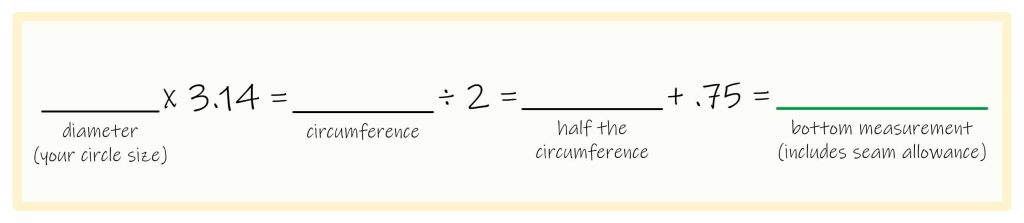
Use the example above to figure how wide to make the bottom of each side panel
Calculate the top width of each panel:
- Multiply the inside top diameter × 3.14 to get circumference.
example: 10 x 3.14 = about 31 1/2 inches
It’s better to round UP than down for the top measurement. The top of the basket is where fit problems show up most; a slightly generous top gives you more wiggle room for an uneven rim, a wider lip, or a basket that flares more on one side. - Divide by 2
example: 31.5 ÷ 2 = 15 3/4 inches - Add 3/4″ for side seams.
example: 15.75 + 0.75 = 16 1/2 inches
The top measurement of each of your side panels is 16 1/2 inches.
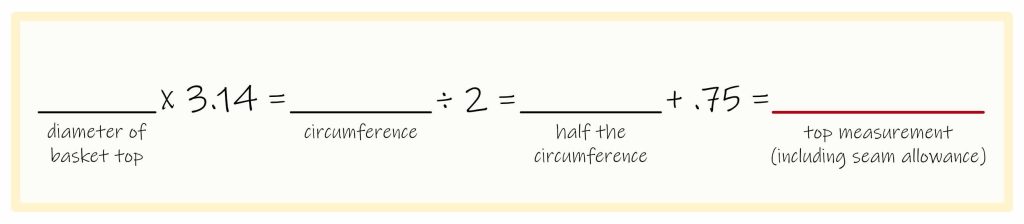
Use the example above to figure how wide to make the top of each side panel
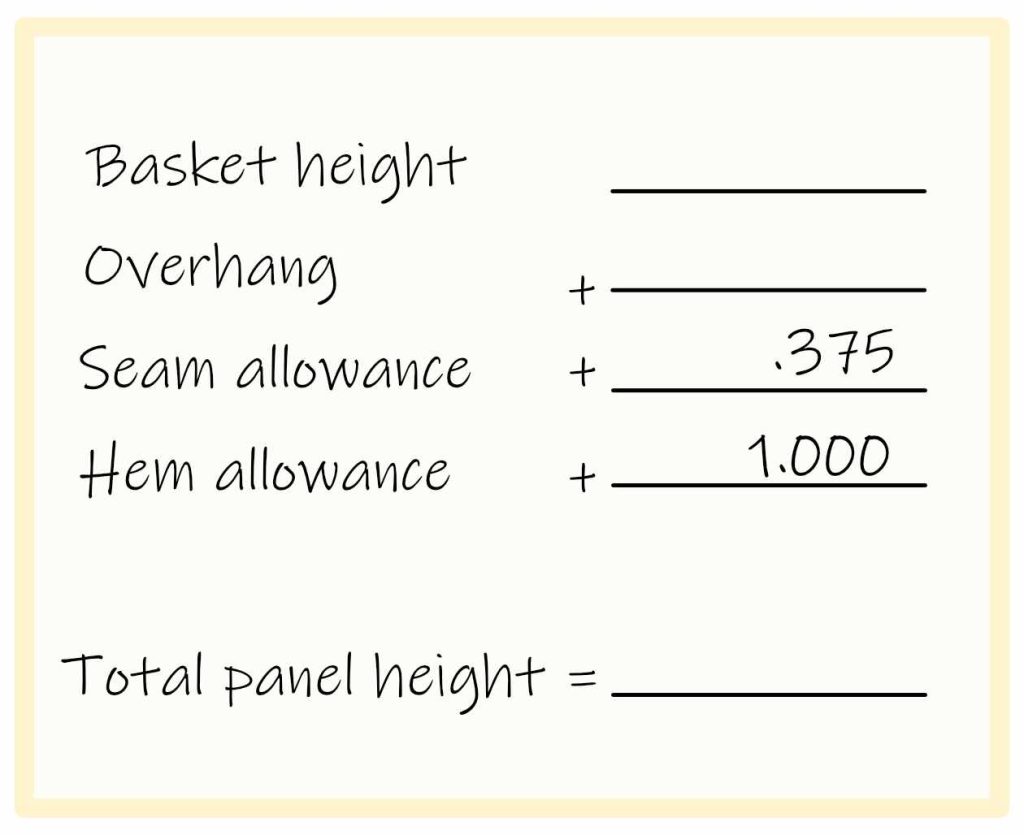
Calculate the height of each panel:
Add these numbers together:
- the height of your basket
- + amount of overhang you want
- + .375 (that’s 3/8″, your bottom seam allowance)
- + 1 (an ample, double-fold 1/2″ top hem allowance)
example: 7″ height + 2″ overhang + 0.375″seam allowance + 1″ hem = 10.375″
Round up to 10.5″ or even 11″ because you can always trim, but you can’t add fabric back.
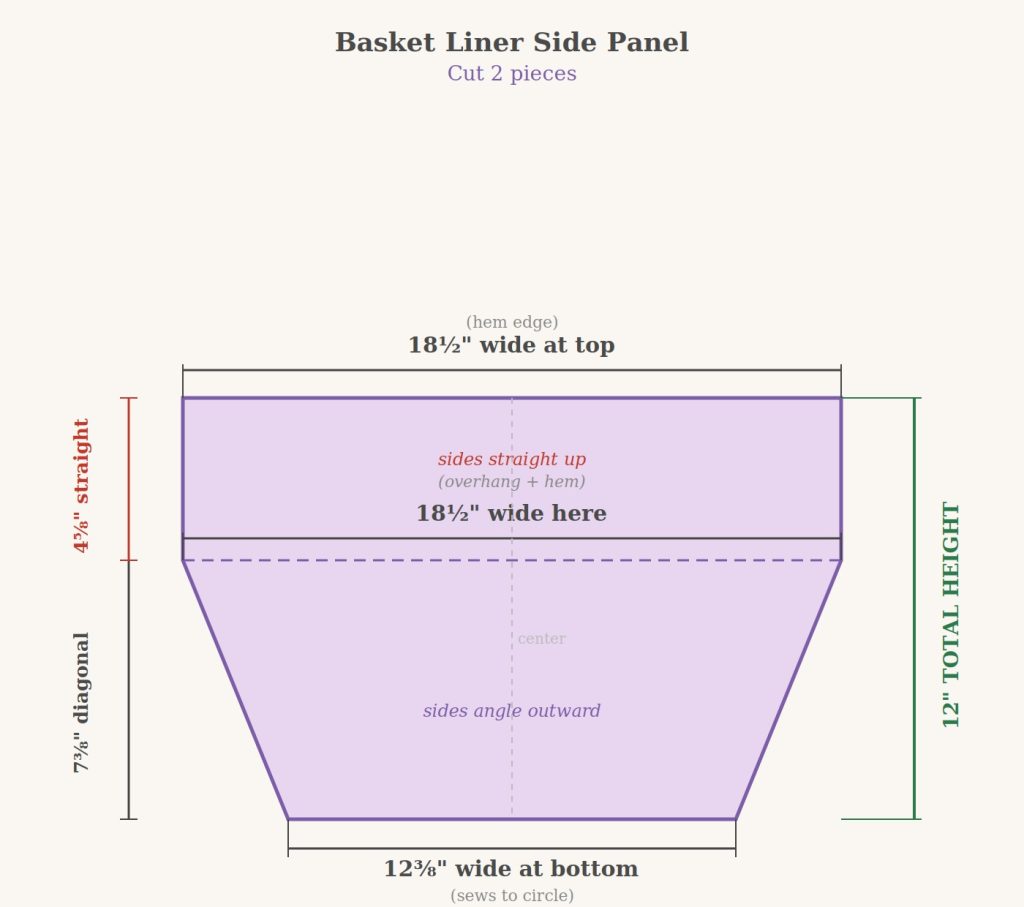
How to draw and cut the panel shape:
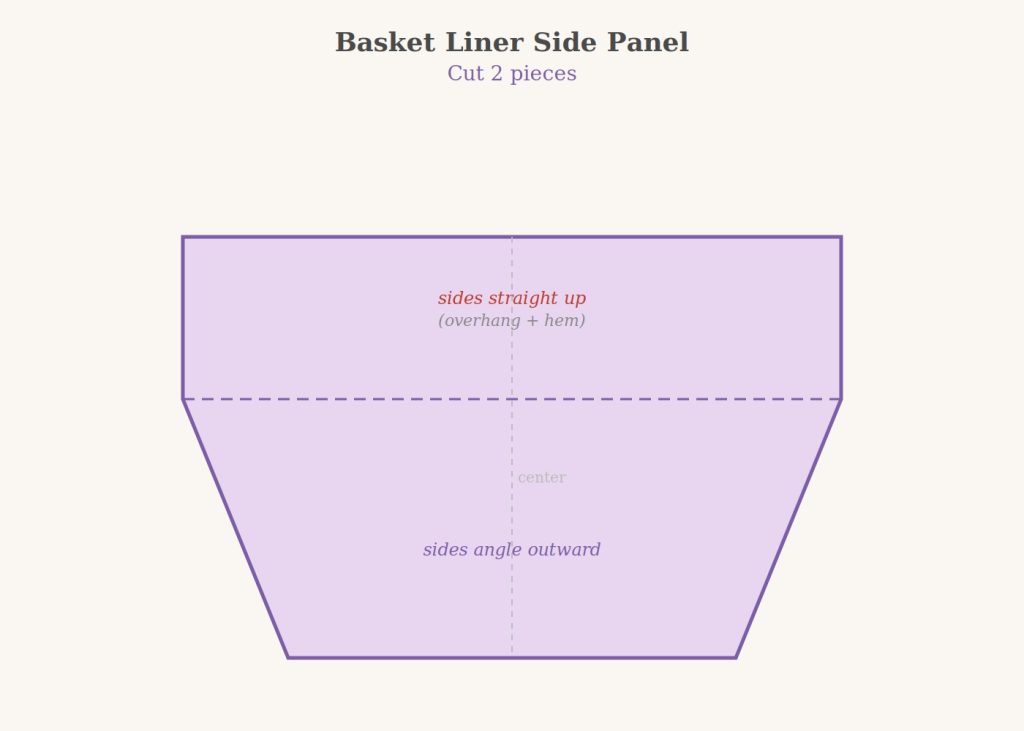
The bottom of your panel is narrower than the top. The sides angle outward — but only for the height of the basket. Above that point, the sides go straight up for the overhang and hem.
Tip: You can layer two pieces of fabric on top of each other and cut both side panels at once, saving time and ensuring they’re identical.
- Measure your fabric to make sure it is at least as wide as your top measurement. If it isn’t, choose a wider piece of fabric before you begin.
- Fold your fabric in half lengthwise, matching the edges evenly, and press with an iron. This crease is your center line.
- Open the fabric back up. Using a fabric marking pen, mark the center point at the top edge and at the bottom edge of where your panel will be.
- Near the bottom of your fabric, find the center crease. Measure half your bottom width (Measurement B) in each direction and mark each end. Draw a horizontal line to connect them. This will be the bottom of your side panel.
- Starting at the center of your bottom line (B), measure straight up along the center crease a distance equal to Measurement H. Mark this point. This is the top edge of your side panel.
- At that top mark, measure half of Measurement T in each direction and mark each end. Draw a horizontal line to connect them. This is the top edge of your side panel.
- From the top edge, measure straight down along each side a distance equal to your overhang + 1″ hem. Mark both ends and draw a horizontal line connecting them. This is your transition line.
- Connect the outer ends of the transition line to the outer ends of the bottom line (B) with a straight diagonal line on each side. These are your angled side seams.
- Draw a straight vertical line on each side from the outer ends of the transition line up to the outer ends of the top line. These are your straight sides.
- Cut along all the outer edges of your marked shape.
Step 4: Press Your Hems Before You Sew
Before sewing anything together, iron the top hem on both side panels. Fold over 1/2″, press, then fold again and press. Don’t sew it yet — just iron it so the crease is set. It’s so much easier to do this while the fabric is flat!
Step 5: Sew the Side Seams
Place your two panels right sides together, lining up the edges. You’ll notice the angle changes partway up — that’s your landmark. You only sew the angled (diagonal) portion of the sides, not the straight overhang section, because that’s where the handles go through.
- Match up the two sides, right sides together. Pin or clip the angled sections together on both sides.
- Starting at the angle-change point (where the diagonal meets the straight), backstitch and sew down toward the bottom with a 3/8″ seam allowance. Stop at the bottom corner and backstitch.
- Repeat on the other side seam.
- Backstitch at both ends — these seams take stress, especially at the bottom corners!
Step 6: Hem the Open Handle Edges
You now have four raw edges that aren’t sewn — two on each side of the liner, where it will open around the basket handles. Hem each of these with a simple double fold: fold over about 1/4″, press, fold again, and sew.
Step 7: Sew the Bottom Circle
This is the trickiest step, but take it slowly and you’ll be just fine.
- With the side panels right sides together and sewn, place your circle right side down against the bottom opening. Match the fold-line creases on the circle to the side seams — this keeps everything centered.
- Pin or clip around the circle, or use double-sided sewing tape (DST) to hold it in place. Pin one quarter section at a time.
- Sew slowly, with the circle on top so you can see what you’re doing. Focus only on the small section of fabric directly under the needle. The rest of the fabric will feel and look wonky — that’s normal. Just keep bringing the bottom edge of the side panel in line with the circle, a little at a time.
- It takes patience, but it absolutely works. Sew all the way around with a 3/8″ seam allowance.
Step 8: Make and Attach Your Ties
You’ll need four ties total — one for each open edge where the liner goes around the handles. You can use ribbon, or make your own fabric ties.
For fabric ties: cut strips about 1″ wide and 9″–12″ long. Fold in half lengthwise, press, fold the raw edges in toward the center crease, and topstitch. Or use ribbon if you prefer a quicker finish!
Pin a tie to each open hemmed edge, about 1″–2″ down from the top. Sew securely with a small rectangle of stitches and backstitch well — these ties will be pulled.
Step 9: Sew the Top Hem
Remember that hem you ironed back in Step 4? Now it’s time to sew it. Since the crease is already set, this is straightforward — just topstitch along the folded edge all the way around the top of the liner.
Step 10: Fit Your Liner and Tie the Bows
Drop your finished liner into the basket, bring the sides up and over the rim, and thread the open edges around the handles. Tie each pair of ties into a bow on the outside of the basket.
Fill with Easter grass, eggs, and treats — and enjoy your beautifully lined Easter basket!
Quick Reference: Cut Sizes for my Example Easter Basket
If your basket is approximately 8″ diameter at the bottom, 10″ at the top, and 7.25″ tall with about 2.5″ overhang, you can use my measurements:
- Bottom circle: 7 3/8″ diameter
- Side panels (cut 2): 12 3/8″ wide at bottom, 16 1/2″ wide at top, 12″ tall
- Diagonal sides for the first 7 5/8″ of height, then straight up for the remaining 4 3/8″
PIN: Save this tutorial for next Easter — or make one for every season!
Leave a Reply